DIAGNOSIS
Structural diagnosis of human systems
A diagnosis examines the structure of a system before it is improved, automated, redesigned, or acted on further.
It focuses on the conditions, constraints, decision dynamics, and recurring patterns that shape how the system operates.
Those patterns may appear as recurring friction, unclear decisions, stalled coordination, or initiatives that create movement without making the system clearer.
Rather than starting from a predefined business function — marketing, operations, culture, strategy, or performance — System Diagnosis starts from the configuration producing the behavior of the system.
01. scope
What a diagnosis is
A diagnosis examines the structure of a system before attempting to change its behavior.
It focuses on the conditions, constraints, decision dynamics, and recurring patterns that shape how the system operates.
Its purpose is to make the system legible enough for action to be judged more clearly.
structural reading
A diagnosis reconstructs how the system is actually organized, rather than how it is described.
RECURRING PATTERNS
It identifies patterns of friction, ambiguity, delay, or non-compounding effort that may point to deeper structure.
before ACTION
Its purpose is to clarify the system before decisions, redesign, automation, implementation, or further execution are pursued.
02. EXAMINATION
What a diagnosis examines
A diagnosis examines the structure beneath recurring behavior.
It looks at how roles are arranged, how decisions move, where constraints sit, and where friction or ambiguity begins to concentrate.
The aim is not to explain everything, but to isolate the structural conditions that most influence how the system operates.
roles
How responsibility, authority, and constraints are distributed.
decision flows
How information moves into judgment, coordination, and action.
constraints
What limits the system, blocks change, or shapes possible outcomes.
RECURRING patterns
Where friction, delay, ambiguity, or non-compounding effort appear.
03. artifact
What a diagnosis produces
A diagnosis does not produce an execution plan.
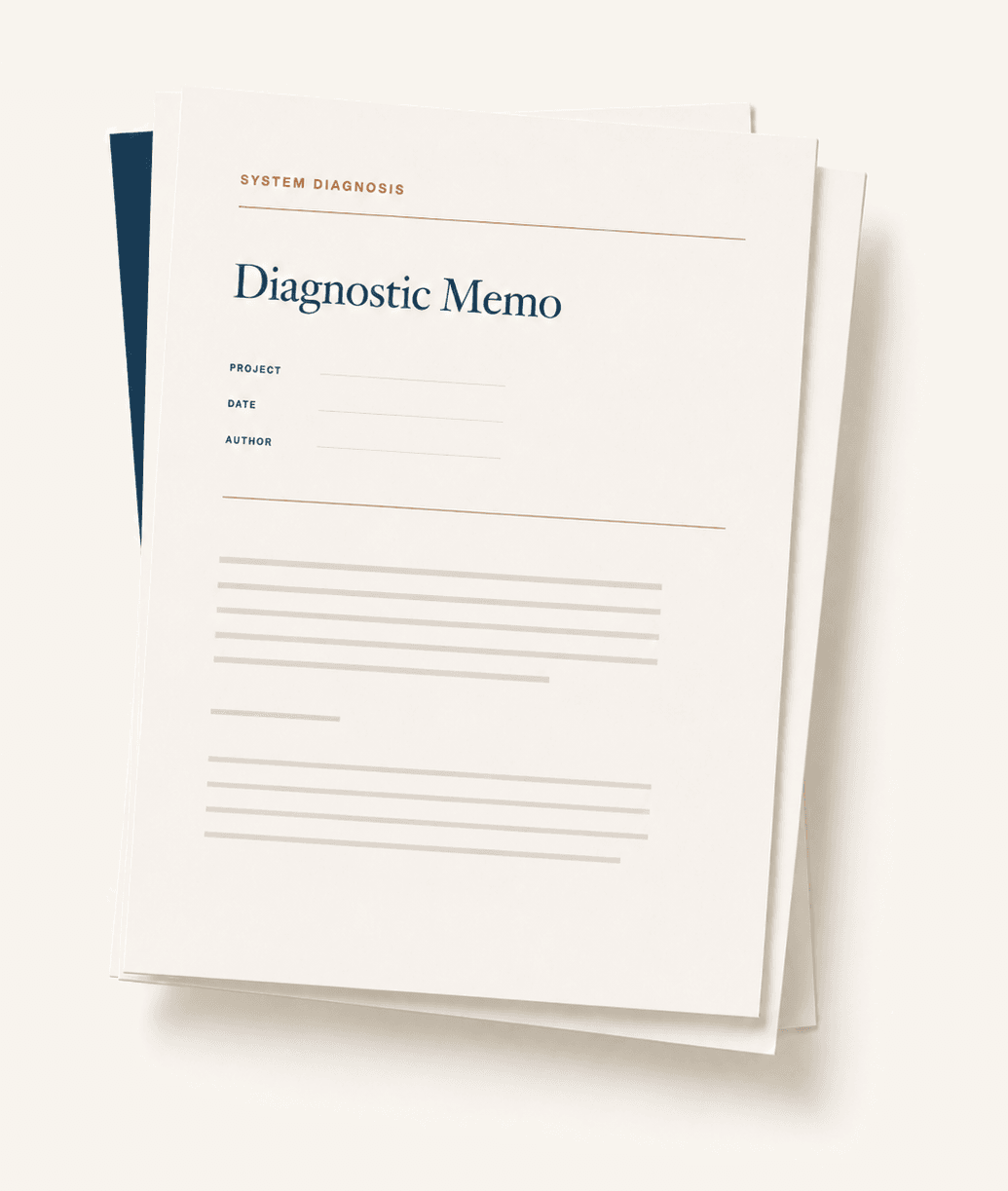
It produces a written artifact — a Diagnostic Memo — that reconstructs the system, identifies the main sources of friction or ambiguity, clarifies the constraints shaping the situation, and frames what should be understood before further action is taken.
The purpose is not to prescribe implementation.
The purpose is to make the system legible enough to separate structural causes from operational noise, understand which signals actually matter, and identify which decisions deserve attention next.
structural reading
A reconstruction of how the system is actually operating.
friction analysis
The main points where misalignment, delay, ambiguity, or distortion are being produced.
constraint clarity
What is blocked, premature, dependent on missing conditions, or difficult to change from inside the current structure.
decision orientation
Possible directions for judgment without prescribing execution.
04. BOUNDARIES
What this is / what this is not
A diagnosis has a specific purpose and specific scope.
These boundaries protect the quality of the work and the clarity of the outcome.
WHAT THIS IS

Independent diagnosis
An external, independent reading of the system

WRITTEN ARTIFACT
A structured Diagnostic Memo that can be reviewed, referenced, and used for judgment.

bounded scope
A focused examination of a defined system, situation, or recurring pattern within an agreed boundary.

structural clarity
Clarity about how the system is operating, what is shaping it, and what needs to be understood before action.
WHAT THIS IS NOT

not FUNCTION-LED
May involve business functions, but analyzes the structure behind the observed situation.

NOT COACHING
Not focused on motivation, performance, or individual development.

NOT IMPLEMENTATION
Possible directions may be outlined, but implementation plans are not designed or managed.

NOT EXECUTION SUPPORT
No operational, advisory, or execution support is provided by default.
05. FIT
When a diagnosis is appropriate
A diagnosis is appropriate when a system keeps producing a pattern that is difficult to explain from the surface.
That pattern may appear as recurring friction, stalled decisions, unclear ownership, coordination drag, non-compounding effort, or uncertainty before a consequential change.
It is especially useful when reasonable fixes have already been attempted, but the underlying pattern remains.
This includes situations where new processes, clearer communication, better tools, role changes, meetings, dashboards, automation, or execution pressure should have helped — but did not clarify what was actually producing the issue.
A diagnosis is less appropriate for isolated tasks, quick advice, execution support, or situations where the system boundary is not clear enough to examine.
RECURRING PATTERNS
The same issue keeps appearing in different forms.
FAILED SURFACE FIXES
Reasonable interventions improve activity, but do not change the underlying pattern.
UNCLEAR OWNERSHIP
Responsibility exists formally, but is difficult to exercise or does not come with enough control.
UNCLEAR DECISION SPACE
The system has options, but it is not clear what frame, constraint, or trade-off is shaping them.
NON-COMPOUNDING EFFORT
Work is happening, but progress does not accumulate.
Describe a system worth diagnosing.
If reasonable fixes have not changed the pattern, the issue may be structural. System Diagnosis may help make the system clearer.